2025
3’x5′
Mixed Media
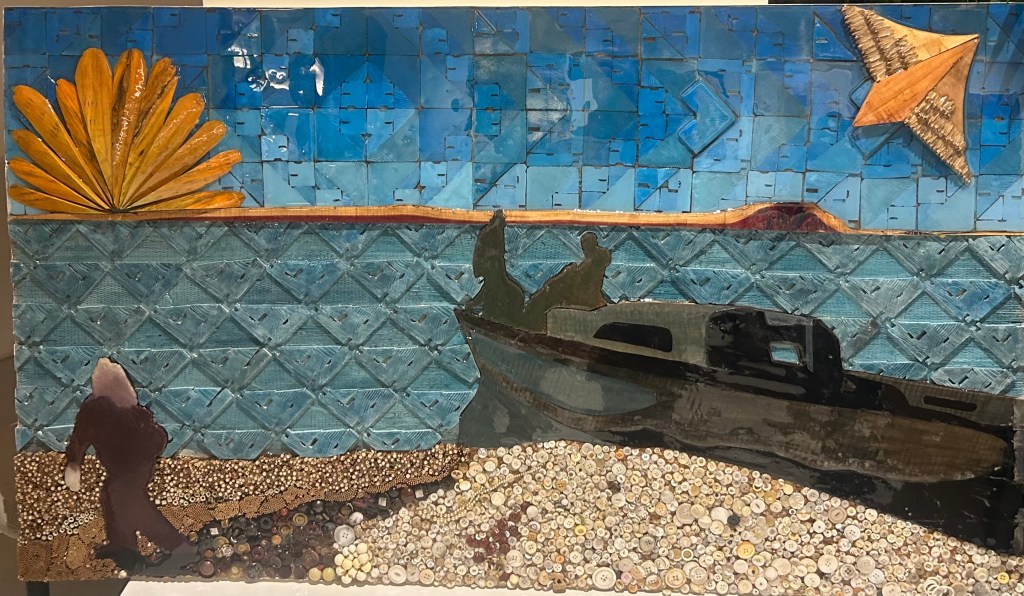
Shoreline Inheritance incorporates scraps from past and present to depict an adventure with my kiddo and friends on the spit between Squantum and Thompson Island where a small boat had become grounded ashore and abandoned, its wreckage colored by various tones of greens and browns of marine decay.
I’ve always been drawn to ruins, scraps, and other evidence of once whole objects, structures or garments. I would, and still do, imagine what once was, and find joy playing with what’s left, with a wisp of feeling sadness and loss. As a kid, my family would visit the Harbor Islands and explore the decaying forts and pick berries. On Peddock’s Island, there was an old vehicle tucked between two buildings, a building that we would enter through a broken window that had an elevator in it, streetlights still standing between norway maples that had grown so close to them that the streetpoles seemed to just be part of the stand of trees. There was an ancient seeming fire hydrant squatting lonely in front of one of the overgrown buildings. The berries were further down on the ocean side of the island where the disappearing gun emplacement ruins were – giant rings hung on tall concrete walls that once had big ropes or cables threaded through them to raise the barrels of the guns over the walls, and the recoil of the shots would force them back down into place behind the wall to reload them.
Bumpkin Island was the closest to our home in Hull and was the island that my Grandma Sally’s sewing room in the attic overlooked. I remember looking for treasures in the attic, being so creeped out by the dress form in her sewing room and also intoxicated by the old wood smell up there. As a kid, my Dad and his friends would sail out to Bumpkin and throw bricks at the crumbling walls of the Burrage Children’s Hospital which had succumbed to fire in 1946 and cheer when bits of walls would come down. It had operated as a hospital for children with physical disabilities from 1902 until World War I, when the island was used by the Navy as a training station. After the war, the hospital reopened for polio patients but was eventually closed during World War II. I was a ranger on Bumpkin Island in 2009 where I attempted to sculpt the sea of bricks from the hospital ruins into paths to showcase sculptures. I had been making giant wheelchairs from the oriental bittersweet vines that had overgrown the island as a point of departure for telling the history of the island as a hospital for disabled children. Lore is that the handicapped ramp was invented on Bumpkin Island. However, the sea of poison ivy that protected the ruins got the better of my efforts and I spent two weeks with swollen, itchy, and pussing arms and legs. I felt like some kind of a mermaid forced to live on the land, my only relief was being submerged in the salty cool harbor water.
The buttons from my grandmother’s sewing room overlooking the harbor eventually made it to me. I imagine that she had inherited buttons from her grandmothers who likely also inherited buttons from their mothers and grandmothers. This Fall, I looked for a button to fix my kiddo’s sportcoat which they were excited to wear to “dress to impress” day at the school’s spirit week, and I realized that a lot of the old white buttons are made out of shells, which would be the perfect material for the shoreline texture that I was creating in the collage that would become Shoreline Inheritance. I began sorting through the buttons to separate the shell buttons and I found many glimpses into the lives of my ancestors: an Army uniform button from my Great Uncle, WWII ration tokens, a coin from Austria from 1851.
I had initially conceived of Shoreline Inheritance as a post-apocalyptic take on a traditional landscape/seascape, and then the whole button experience made it a lot more personal. I thought about the women who came before me who fixed clothing and made clothing. How they saw the beauty in such small things and saved them in tin after tin of buttons of all colors, shapes, sizes and materials. I love the idea of returning the shell buttons to the shoreline in this piece. I imagine the thousands of buttons that fell off of people’s garments into the sea over thousands of years washed up on this imaginary shoreline.
I think about the collective cultural inheritance of our coastal environment – full of wreckage, treasures, and everything in-between, ready for renewal, a new season, new cycles, and growth. I imagine what the shoreline was like when it was well cared for by the original indigenous inhabitants of the land and waterways who were deeply interconnected with all the plants and creatures who they shared it with. As our shorelines recover from generations of extraction and dumping and still continue to be mistreated alongside conservation and restoration efforts, I think about how I am a bridge between the past and the future. In my lifetime I cannot recreate a whole landscape that took generations to establish balance and biodiversity, nor can I recreate a lineage that is rooted in reciprocal relationship with the land as the capitalist system that we have and continue to be part of functions on systems of extraction. As I struggle to create beauty from the scraps of my familial and cultural inheritance, my wish is that my engagement with the land and people who care for it inspires the next generation to center care and active engagement in our land, waterways, and communities.
Shoreline Inheritance incorporates scraps from past and present to depict an adventure with my kiddo and friends on the spit between Squantum and Thompson Island where a small boat had become grounded ashore and abandoned, its wreckage colored by various tones of greens and browns of marine decay. The children are lasercut from a thin piece of wood that was the backing of a print that came out of the attic in Hull overlooking the Harbor, presumably from my great grandparents, as the print was produced between 1834 and 1907. Scraps also came from old art projects, construction projects on my street, a straw mat which I used to lay on at the beach, blinds I got from the trash, garlic stems from my garden, motherwort from a raised bed in the Southwest Corridor Park, thin veneer wood from a friend in Upstate New York, and of course, buttons from my ancestors.
 Placekeeping / Placehealing