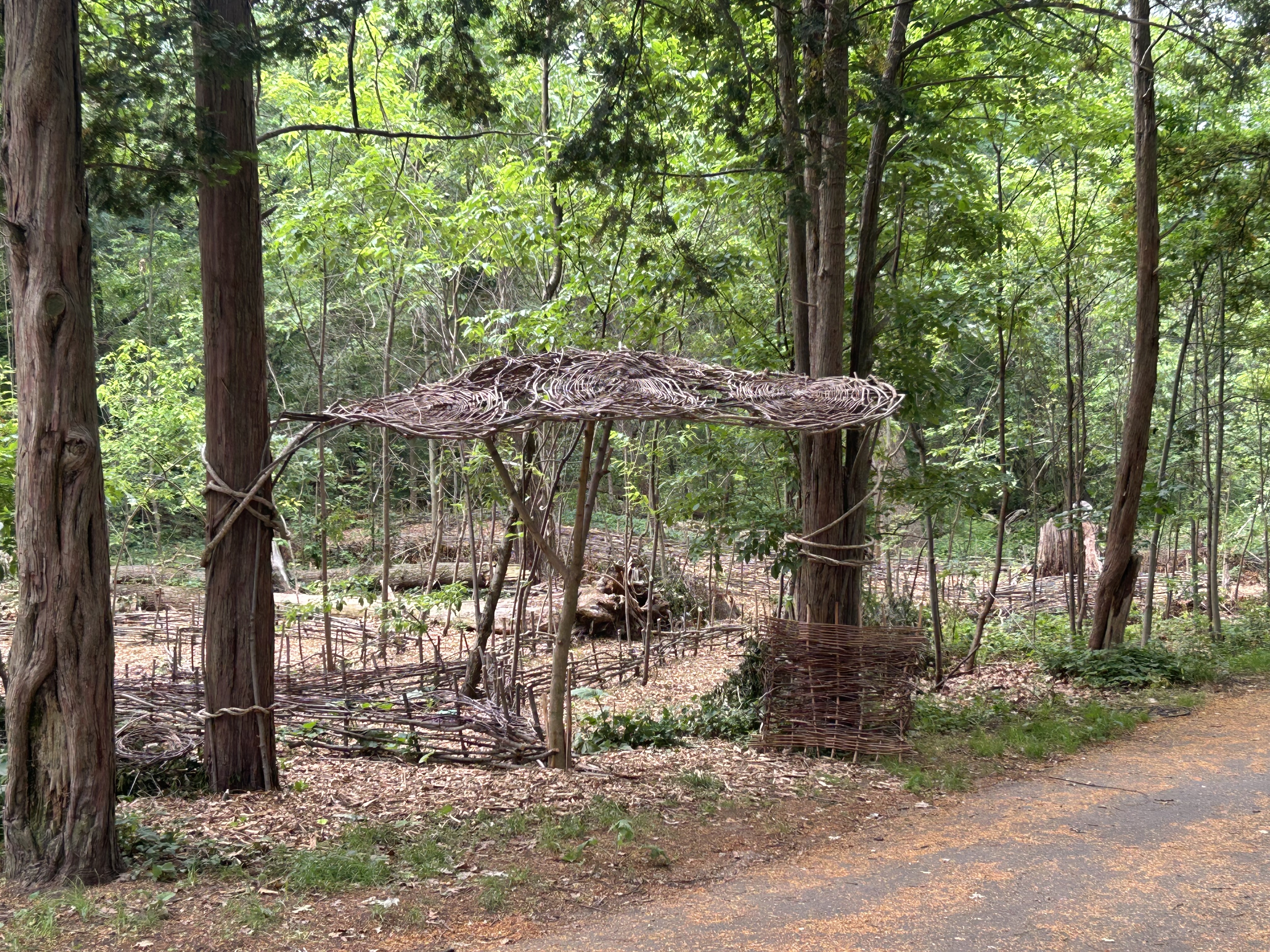
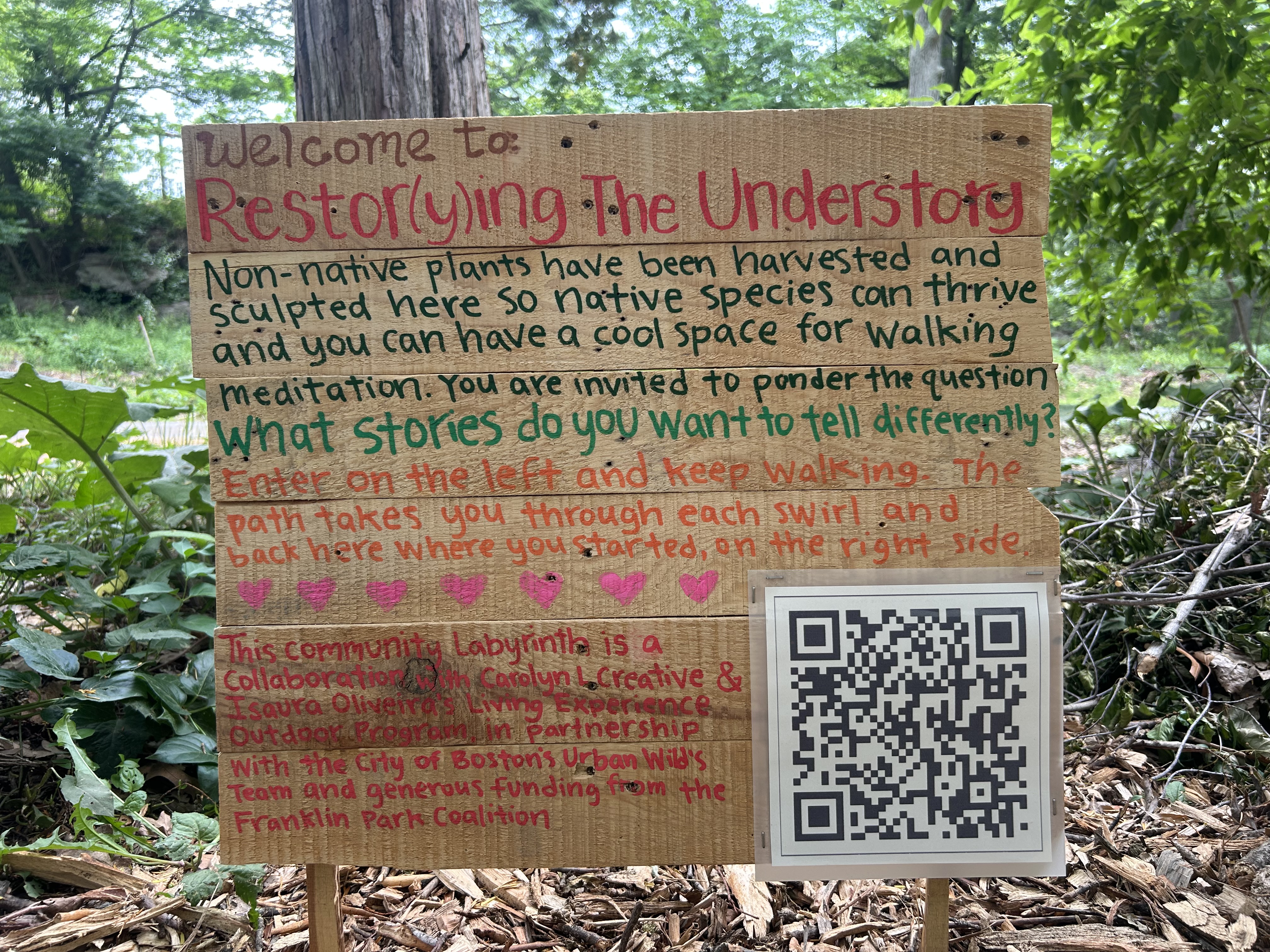
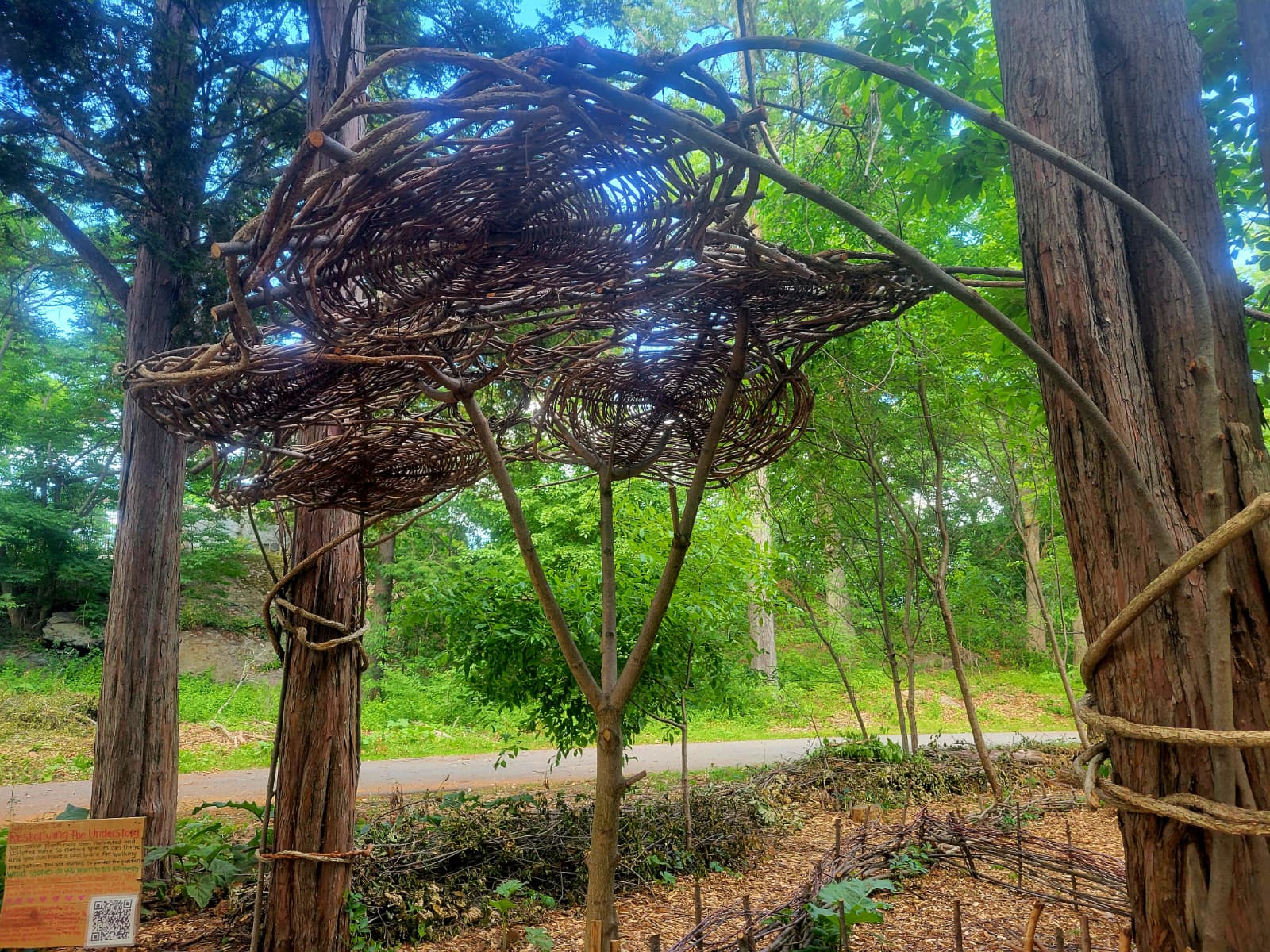
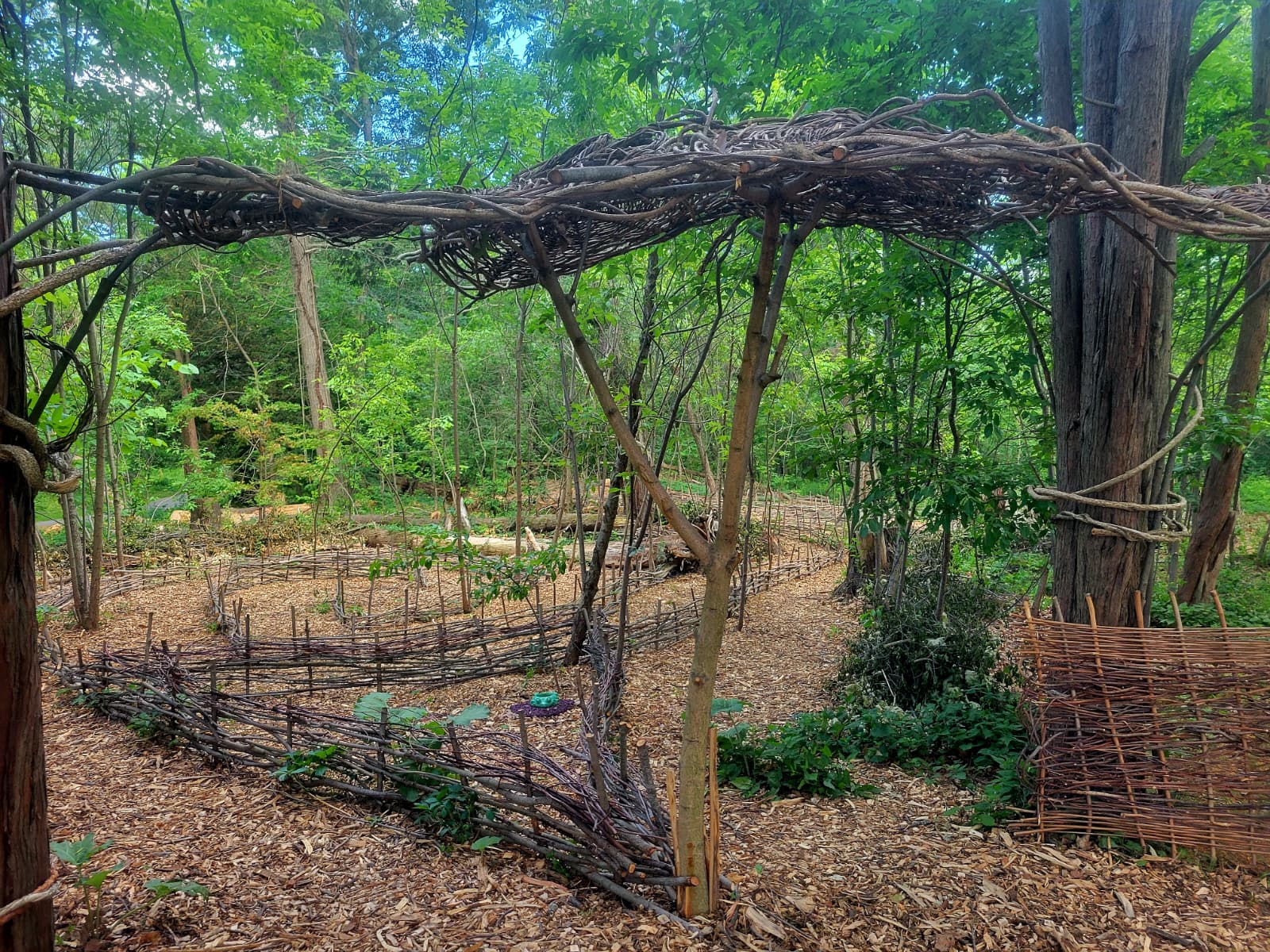
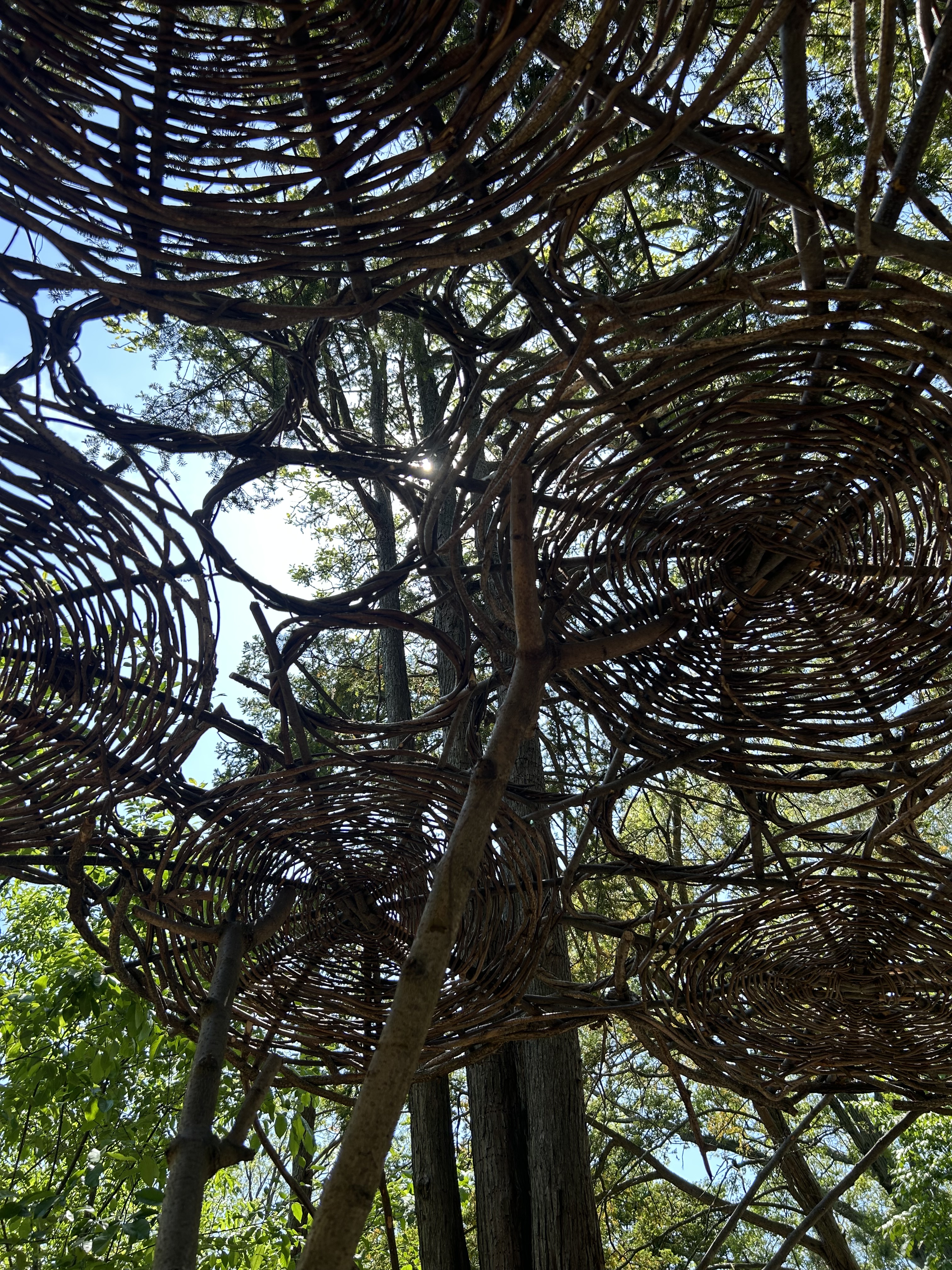
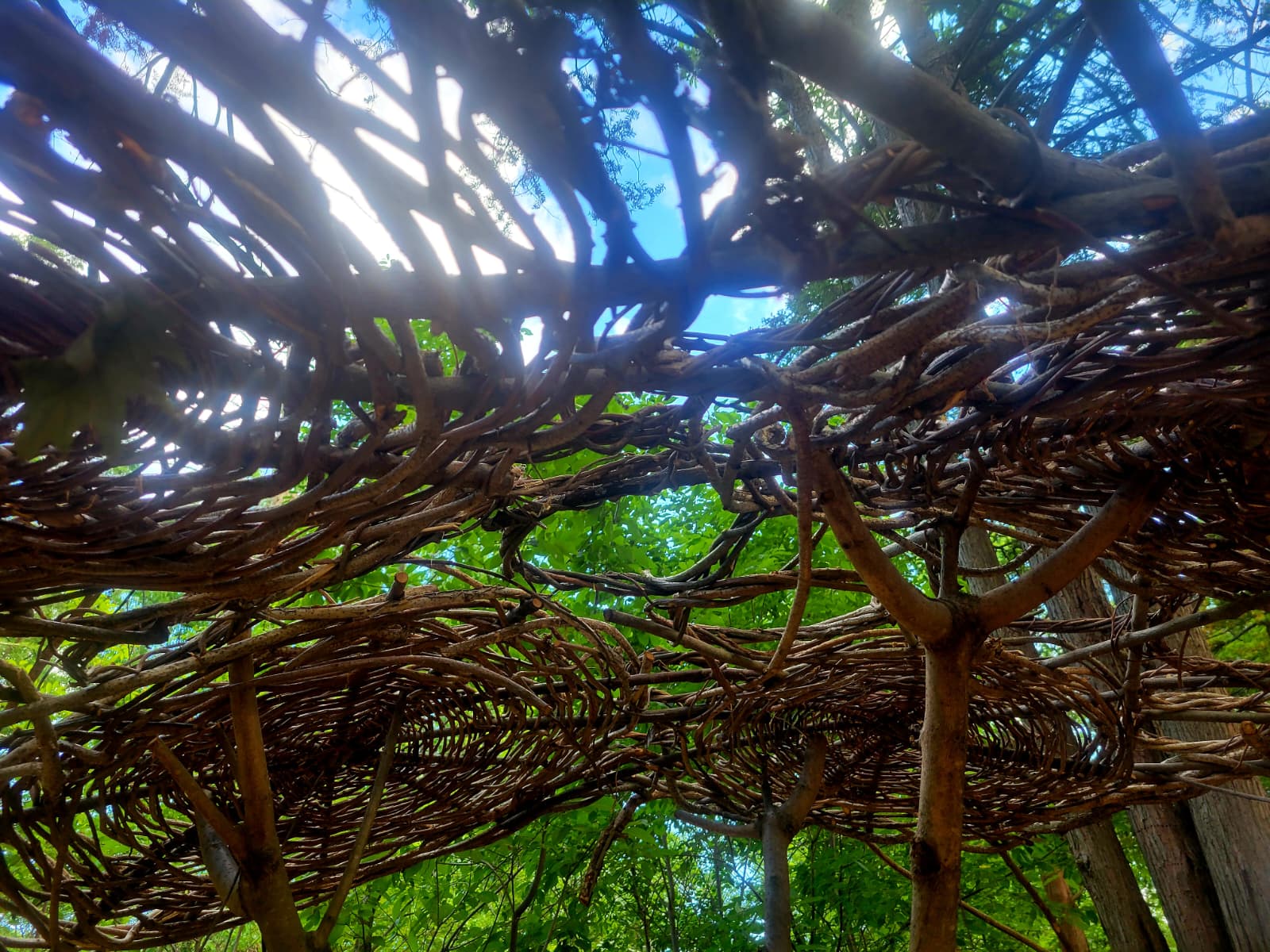
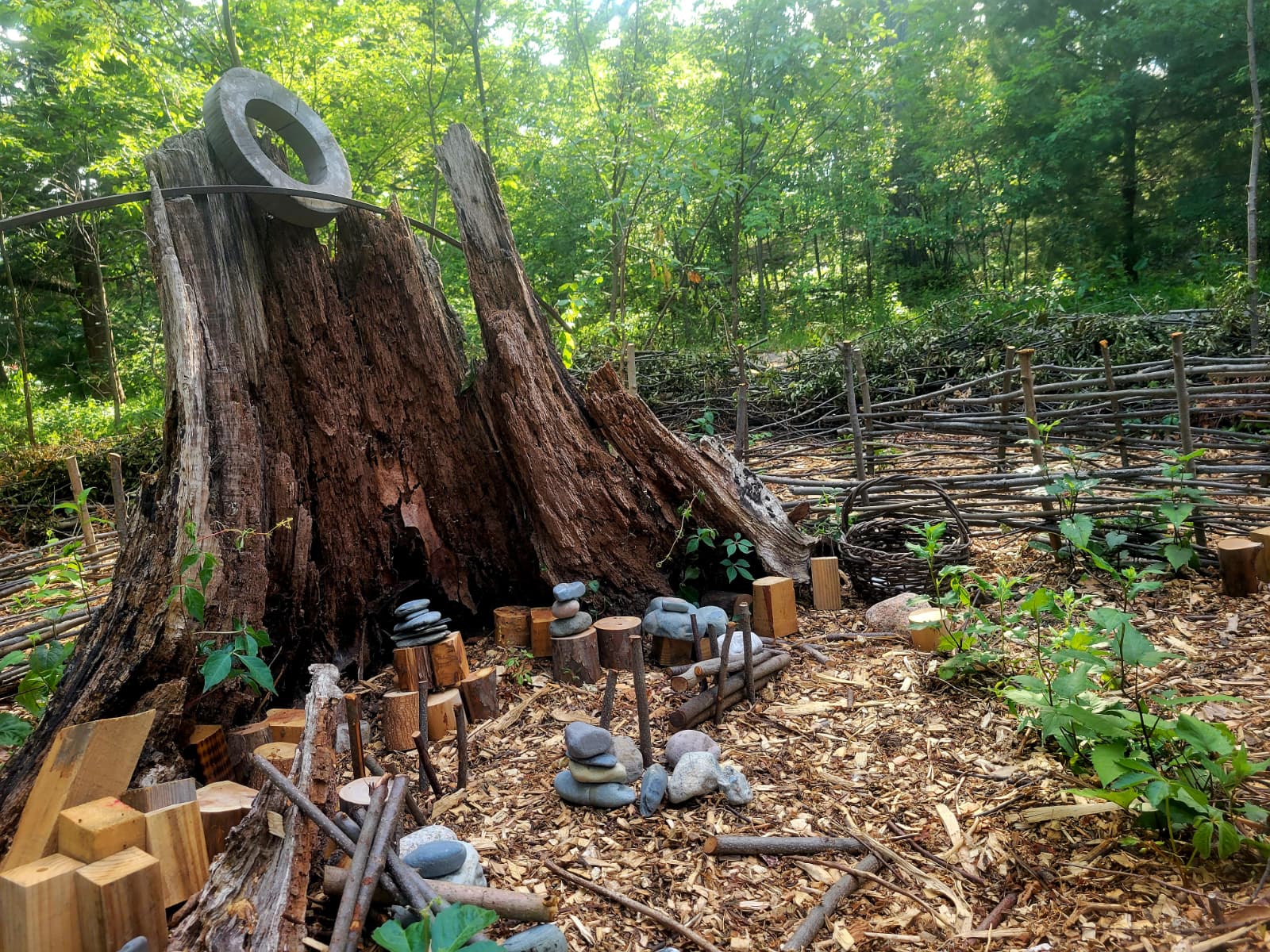
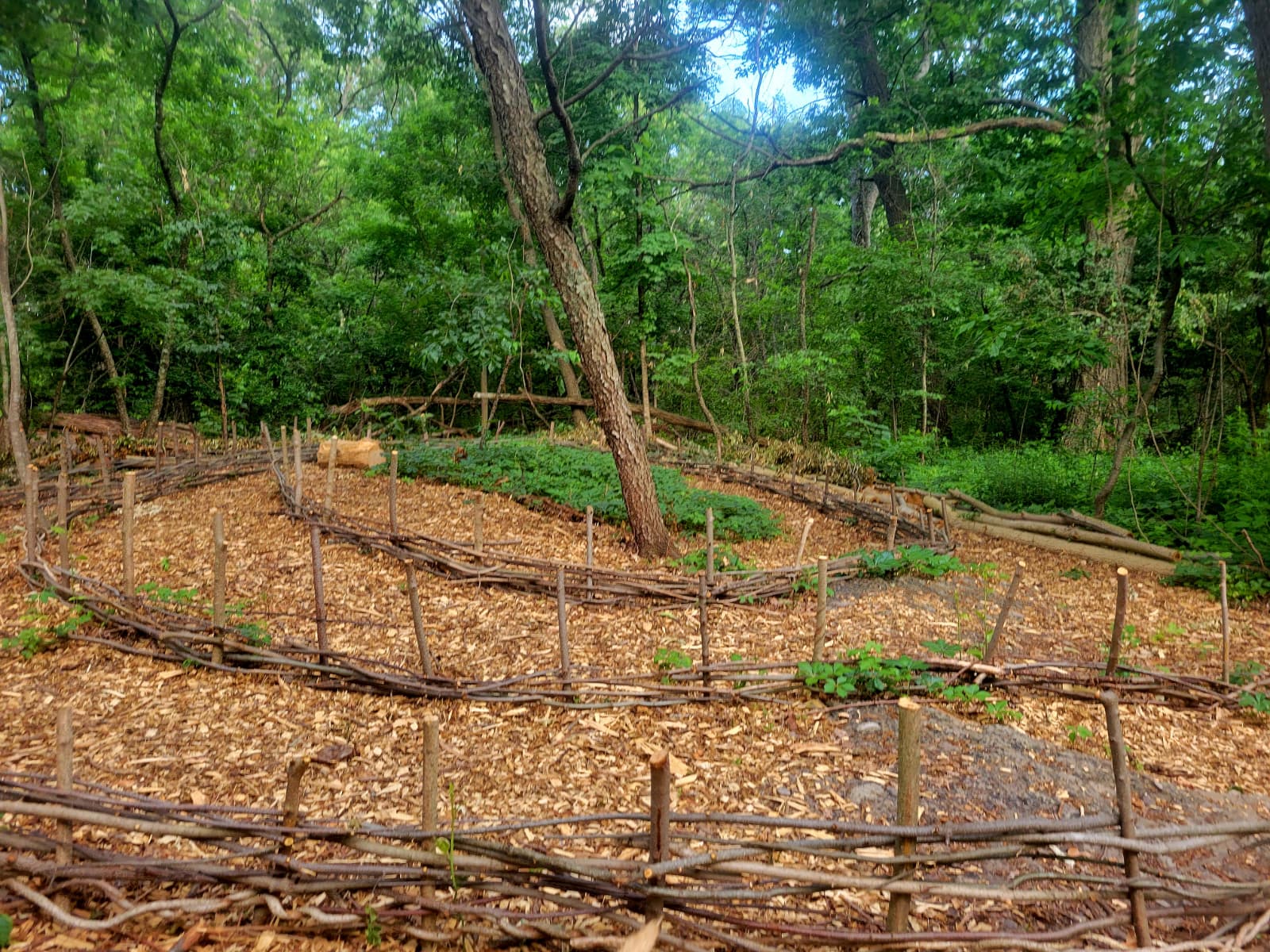
Restor(y)ing the Understory is a community labyrinth that was created from plant materials that the Boston Parks Department Urban Wilds team and volunteers have cleared from Franklin Park as part of efforts to remove non-native plants in the forest understory in order to restore a more biodiverse native habitat.
The labyrinth invites people to walk quietly and practice being present on the earth, with the plants and with each step. The goal of walking the labyrinth is for the participants to calm their nervous systems, feel more at home in the woods, and connect with the magic of nature. As the name implies, the goal of this labyrinth is also to tell stories in a different way. The restorying includes:
- Commonly told story: non-native species that cause imbalances in our ecosystem are “invasive.” (Re)story: non-native species that cause imbalances in our ecosystem offer available resources. Consider that humans have disturbed the land and introduced non-native species, some of which thrive here, and out-compete native species. As humans have created the conditions for these disturbances in the native ecosystem, it’s our job to address it, not villainize the plants. This project uplifts a perspective that these non-native species have gifts to offer. Plants are transformed into something special, they are not killed because they are a problem. The following is a description of some of the useful qualities of the plants that are prominent features in the labyrinth:
- Glossy buckthorn – material used for stakes for weaving onto and for use as a weaving material for fencing
- Oriental bittersweet – material used in making circular forms and for use as a weaving material in the entrance/exit portal, which uses a basketry technique at a large scale
- Norway Maple – material used for stakes for weaving onto and for use as a weaving material for fencing
- Corktrees – material used for stakes for weaving onto and for use as a weaving material for fencing
- Materials in the “habitat walls” around the perimeter of the labyrinth: Lots of Garlic Mustard, crabapple, corktrees
- A variety of plants have been ground into wood chips and utilized on the site to even out the ground and add organic matter into the soil.
- Commonly told story: urban parks are unsafe. (Re)story: urban parks are sacred and magical. People can sense when a place is loved and cared for and are more likely to respect it. The land belongs to mother Earth and when we protect natural systems from human development and allow them to flourish, we also flourish. Centering the Earth and learning her rhythms and how to receive her gifts will nourish us in ways that enrich our spirits in ways that stadiums and golf courses and Zoos can not. In the labyrinth, folx are invited to add their own whimsical offering and co-create a magical space that is always evolving.
- Commonly told story: Ticks and poison ivy are “bad.” (Re)story: ticks and poison ivy play a role in the woodland ecosystem. These species have every right to exist as humans do. Its important for people to learn how to enjoy the woods safely despite these risks. Here are some helpful links to info about ticks and poison ivy. I spent 3 weeks daily in the park making the labyrinth and did not see any ticks, but others have reported seeing them, so it is good practice to check yourself for ticks after spending time in the woods. There is quite a bit of poison ivy in Franklin Park. In the labyrinth, a lot of poison ivy has been killed so that this is a safe space. However it will try to reclaim it’s place over time and it’s important to look out for it.
This project absolutely took a village.
Massive gratitude to:
* The fellow grown ups who still love playing in the woods who helped me drag, prep, and weave Buckthorn saplings into the fencing and building up the perimeter wall with other non-native plant material that had to be removed from the park
* The City of Boston Urban Wilds team for providing wood chips and clearing out non-native plants so our native species have space to grow, and for staging them for me to use in the labyrinth
* The Franklin Park Coalition for funding this incredible project, especially board member Jacob Bor for encouraging me to do this
* Isaura Oliveira who has been an incredible collaborator and thought partner and created an opening ritual for the space.
 Placekeeping / Placehealing